
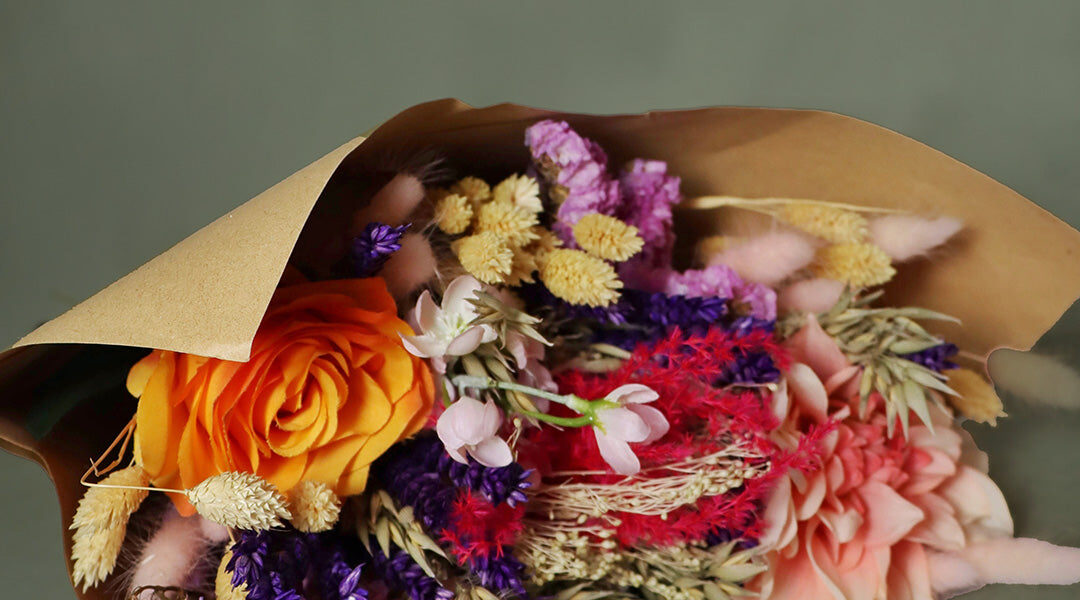
Buying British-grown dried flowers cuts the floral supply chain’s carbon footprint dramatically — most fresh UK florist flowers are air-freighted from Kenya, Colombia, or the Netherlands, while British dried flowers travel hundreds of miles instead of thousands. They also support small UK growers, traditional farming methods, and genuinely seasonal colour palettes the imported trade cannot match.
Not all dried flowers travel thousands of miles to reach your vase. An increasing number of beautiful dried stems are grown right here in the UK — and choosing British-grown dried flowers isn’t just a feel-good decision. It means lower carbon footprint, fresher stock, and stems that are naturally suited to the British climate and seasons.
Here’s what you need to know about UK-grown dried flowers, which varieties grow well here, and why it matters.
Why British-Grown Matters
The majority of dried flowers sold in the UK are imported — from the Netherlands, South Africa, India, and South America. That’s not inherently a problem, but it does mean international shipping, often by air, with associated carbon emissions. It also means the stems have been in transit for days or weeks before reaching you.
British-grown dried flowers eliminate that. They’re harvested locally, dried locally, and shipped domestically — usually by standard courier or Royal Mail. The environmental footprint is dramatically smaller, and the flowers arrive fresher because they haven’t spent time in international logistics chains.
There’s also a seasonal honesty to British-grown flowers. They reflect the actual rhythms of the UK climate rather than offering everything year-round through imports. Sustainability isn’t just about carbon — it’s about connecting with what the land around you actually produces.
What Grows Well in the UK
The British climate is surprisingly good for growing flowers that dry beautifully:
Lavender. English lavender thrives in the UK and produces some of the world’s best dried lavender. The Hampshire and Norfolk lavender fields are famous for good reason. English varieties like Hidcote and Munstead are ideal for drying — compact, deeply fragrant, and richly coloured.
Wheat, oats, and barley. Britain’s agricultural heartland produces abundant grain crops, and the dried stems from these cereals are a staple of dried flower arrangements. Golden, structural, and naturally harvest-themed.
Ornamental grasses. Many dried grasses — including briza, phalaris, and timothy — grow wild in British meadows and hedgerows. They can be harvested from gardens or foraged responsibly from countryside walks.
Statice (Limonium). This hardy annual grows well in UK gardens and dries into vivid purple, pink, white, and yellow flower clusters. It’s one of the easiest flowers to grow specifically for drying.
Hydrangea. British-grown hydrangeas dry naturally on the bush in late summer and autumn, producing those gorgeous antique-toned heads that are so popular in dried arrangements.
Cornflowers. Classic British wildflowers that dry beautifully, retaining their vivid blue colour. They’ve been grown in British fields for centuries.
Nigella (Love-in-a-mist). Both the flowers and the distinctive striped seed pods dry well. The pods are particularly popular in arrangements for their unusual, architectural shape.
Strawflowers (Helichrysum). These grow well in UK summers and are one of the easiest flowers to dry — they’re practically dried on the stem before you even cut them.
Seasonal Availability
British-grown dried flowers follow the natural growing calendar:
Spring harvest: Early grasses, wild flowers, cornflowers.
Summer harvest: Lavender (July–August is peak), wheat, oats, statice, strawflowers, nigella pods.
Autumn harvest: Hydrangea heads, late grasses, seed pods, ornamental alliums.
Winter: No fresh harvest, but stems dried from summer and autumn are available year-round.
This seasonality is part of the appeal. A summer arrangement of freshly dried British lavender and wheat feels connected to the actual season in a way that imported stems can’t replicate.
Growing Your Own
If you have a garden, growing flowers specifically for drying is a rewarding project. Lavender, statice, strawflowers, nigella, and ornamental grasses are all easy to grow from seed in UK conditions. Harvest when flowers are at peak bloom (or just before), and dry using the techniques in our drying guide.
Even a small balcony can produce enough dried lavender and grasses to fill a bud vase — and there’s something genuinely satisfying about displaying flowers you’ve grown and dried yourself.
The Local Choice
Choosing British-grown dried flowers is a small decision with a meaningful impact. Lower miles, lower carbon, fresher stems, and a genuine connection to the British seasons. It’s not about being purist — most beautiful arrangements mix British-grown and imported stems — but knowing where your flowers come from adds another layer of intention to something already beautiful.
Our Edmund Wreath and Matilda Bouquet both feature stems sourced from British growers wherever possible, supporting local floristry and reducing the environmental impact of long-distance shipping.
For a closer look at one of Britain’s most beloved native stems, explore our pussy willow guide. Browse our collection to find arrangements featuring British-grown stems alongside the best of international dried floristry.
Where Do British-Grown Dried Flowers Actually Come From?
The UK has a small but rapidly growing dried flower sector concentrated mainly in Devon, Cornwall, Hampshire, Norfolk, Lincolnshire, and parts of Yorkshire. Most British dried flower growers operate at small to medium scale — usually working a few acres rather than thousands — and many supply florists and wholesalers directly rather than through commodity trade routes. This matters because it means the stems you buy can usually be traced back to a specific farm and harvest.
Our Hampshire workshop sources from a network of small UK growers wherever the season allows. Pampas grass, wheat, oats, gypsophila, statice, larkspur, ammi, and helichrysum all grow well in British conditions and form the backbone of our British-grown stock. Items like eucalyptus are sourced from the southwest where the climate suits, and we top up with European supply (Italy, Spain, Netherlands) when British supply runs out — always cross-checking origin against air-freighted alternatives we deliberately avoid.
Why Does Buying British Make a Real Difference?
The fresh UK florist trade depends overwhelmingly on Dutch and African imports — roughly 90% of fresh cut flowers sold in the UK are imported, with Kenya alone accounting for nearly 40% of cut roses. Each stem has typically travelled by refrigerated air freight to Schiphol or Heathrow, then by chilled lorry to wholesalers, then to florists. The carbon footprint of an imported fresh rose can be twenty to fifty times higher than a British-grown dried equivalent.
British-grown dried flowers skip almost all of that. Field-grown locally, dried by air or careful low-heat processing, transported by road in non-refrigerated conditions, and held in stable storage rather than constant cold chain. The lifecycle environmental impact is a fraction of imported fresh — and the quality is often higher because the stems do not need to survive 48 hours in transit before they reach you.
What Stems Are Reliably British-Grown?
Reliably available from UK growers across most of the year:
- Wheat, oats, barley — agricultural crossover, abundant supply, full British harvests
- Lavender — Norfolk and Hampshire are major UK growing regions
- Statice and larkspur — common British cut-flower farm crops
- Helichrysum (everlasting daisies) — grown by smaller specialist growers
- Gypsophila and ammi — UK farm staples
- Pampas grass — increasing UK supply as demand has grown
- Wild grasses (foxtail, panicum) — local-to-region supply
Stems harder to source British-grown (we use European or careful international supply for these):
- King protea and pincushion protea — South Africa native, no British supply
- Some preserved eucalyptus varieties — limited UK growing
- Cotton stems — primarily US supply
- Specialist tropical varieties — origin-checked individually
How Can You Identify Genuinely British-Grown Dried Flowers?
Three checks before buying:
- Look for explicit origin labelling. Reputable British-focused suppliers will state the source of each stem type. Vague language like “ethically sourced” or “sustainable” without provenance information often hides imported supply chains.
- Check seasonal ranges match British harvests. If a supplier offers the same exact stems all year round at the same price, the supply chain is almost certainly imported. British-grown supply has natural seasonal availability windows.
- Ask the supplier directly. Small UK businesses will tell you exactly which farms or growers their stems come from. We are happy to do this for any specific bouquet — drop us a line at hello@driedflowers.uk.com.
Frequently Asked Questions About British-Grown Dried Flowers
Are all your dried flowers British-grown?
The majority are British or European, but not all. We are transparent on individual product pages where stems are sourced from outside the UK. Some varieties (protea, cotton, certain tropical stems) cannot be reliably grown in the UK climate, so we source them from origin countries with the smallest possible supply-chain footprint.
Are British-grown dried flowers more expensive than imported?
Slightly, but not dramatically. UK growing costs more per stem than industrial-scale Kenyan or Dutch production, but you save on cold-chain transport and air-freight costs. The price difference for the customer is typically 10-20% versus deeply imported alternatives — and the quality, traceability, and environmental impact justify it for most buyers.
Why does the British-grown range change through the year?
Because real growing happens in seasons. British wheat is harvested in summer; British lavender peaks in July-August; British helichrysum is mid-summer. Rather than smoothing the year by importing out-of-season supply, we keep our British-grown range honestly seasonal — what is in stock reflects what UK farms have actually produced.
Are British-grown dried flowers better quality?
Often yes, because they have travelled less and been handled less. A stem that goes from a Norfolk field to a Hampshire workshop in a week without ever entering a cold-storage facility is in noticeably better condition than the same species shipped from Kenya, held in warehouse cold-storage in the Netherlands, and then trucked to a UK florist over 4-7 days.
How can I support British dried flower growers?
Buy from suppliers who source British where possible and are transparent about origin. Look for the British Flower Mark (where applicable), and ask directly about provenance. Public demand drives British growers to expand acreage — every British-grown order is a small vote for the sector.
Browse Our Dried Flower Wreaths
Discover handcrafted wreaths for every season, from rustic to contemporary designs.
Shop NowDo British-grown dried flowers last as long as imported ones?
Yes, often longer. British growing conditions tend to produce stems with stronger structural integrity, and shorter, simpler supply chains mean less mechanical damage. Expect 1-3 years lifespan on display either way, but with British stems you get more consistent quality.