
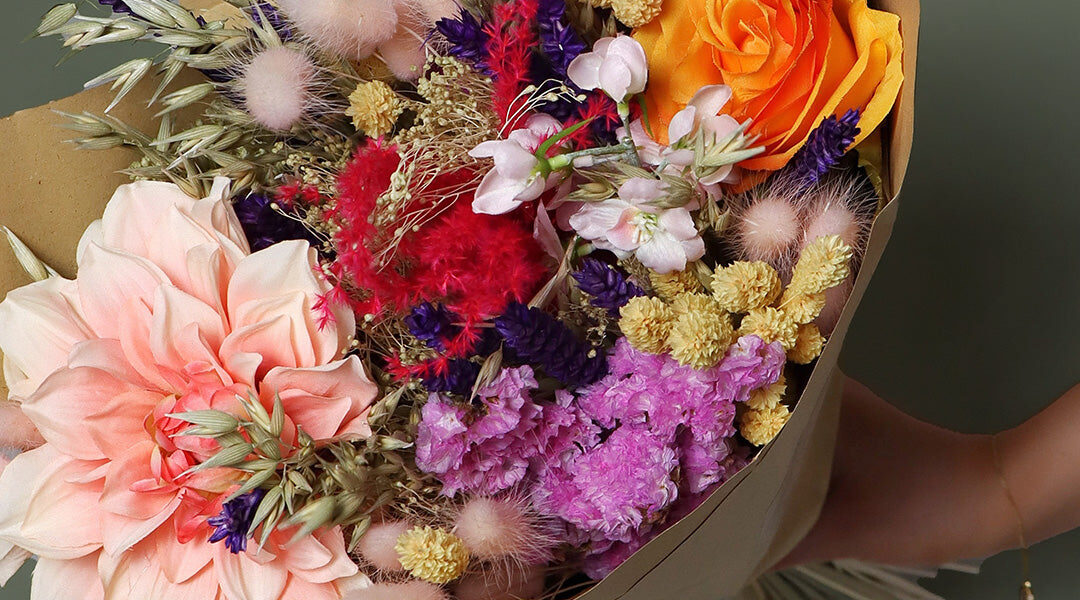
There are five honest ways to preserve a wedding bouquet — air drying, silica gel, pressing, professional freeze-drying, and resin encasing. Air drying is the easiest and cheapest; silica gel keeps the most colour; freeze-drying preserves the original form best; and pressing works for keepsake frames. The right choice depends on what you want the result to look like.
You spent weeks choosing your wedding flowers. They were perfect on the day — the colours, the textures, the way they complemented your dress. And then, like all fresh flowers, they started to fade. If you want to keep your wedding bouquet rather than watch it wilt in a vase, preservation is the answer. And honestly? A preserved wedding bouquet can look even more beautiful than the original.
Here’s how to preserve your wedding bouquet at home — and what to do if you’d rather leave it to a professional.
How Do You Air-Dry a Wedding Bouquet?
Air drying is the most accessible preservation method and works well for many wedding flower varieties.
How to do it: Remove any wrapping, ribbon, or wet foam from the bouquet. Separate the stems into smaller bundles of five to eight stems — thick bundles trap moisture and encourage mould. Hang each bundle upside down in a warm, dry, well-ventilated space using twine or rubber bands. An airing cupboard or spare room works perfectly.
Timing matters. Start the drying process as soon as possible after the wedding — ideally within 24 hours while the flowers are still fresh. The longer you wait, the more the flowers deteriorate before drying begins, and the worse the final result will be.
How long: Two to three weeks. The flowers are ready when stems snap cleanly and petals feel papery.
Best for: Roses, lavender, baby’s breath, eucalyptus, hydrangea, and most greenery. These flowers hold their shape well during air drying.
Less ideal for: Peonies, dahlias, and lilies — these flowers have high water content and tend to shrink significantly when air-dried. For these, silica gel drying produces better results.
How Do You Use Silica Gel to Dry Wedding Flowers?
If you want your preserved flowers to look as close to fresh as possible, silica gel is the method to use. It draws moisture from the petals quickly and evenly, preserving both shape and colour far better than air drying.
How to do it: Pour a layer of silica gel into an airtight container. Place individual flower heads face-up on the gel, then gently spoon more gel around and over each petal until completely covered. Seal the container and leave for five to seven days.
Silica gel can be purchased from craft shops or Amazon in reusable tubs. It changes colour when saturated with moisture, so you can see when it’s done — and it can be dried out in the oven and reused for future projects.
How Do You Press Wedding Flowers for a Frame?
If you’d like to frame individual flowers from your bouquet rather than preserve the whole arrangement, pressing is a lovely option. Place individual flower heads or petals between parchment paper inside a heavy book, stack more books on top, and wait three to four weeks.
Pressed wedding flowers framed behind glass make a beautiful, permanent keepsake for your home — and they’re a wonderful first-anniversary gift idea.
Should You Use a Professional Wedding Bouquet Preservation Service?
If you’d rather not risk your precious wedding bouquet on a DIY project, professional preservation services can produce stunning results. Specialists use advanced techniques — freeze-drying, resin encasing, and professional-grade silica drying — that produce results far beyond what’s achievable at home.
Professional preservation typically costs £150 to £400 depending on the method and the size of the bouquet. It’s not cheap — but for something as emotionally significant as your wedding flowers, many couples consider it worthwhile.
The Alternative: Start with Dried
Here’s a thought that’s increasingly popular: skip the preservation question entirely by carrying a dried flower bouquet on your wedding day. It looks stunning in photos, it won’t wilt during a twelve-hour celebration, and it’s already preserved — you simply take it home and display it. No drying process, no professional service, no anxiety about whether the preservation will work.
Our dried wedding flower collection includes bridal bouquets designed specifically as permanent keepsakes.
However You Preserve It
Your wedding bouquet represents one of the most meaningful days of your life. Whether you air-dry it in the airing cupboard, press individual blooms into a frame, or invest in professional preservation, keeping those flowers is a way of holding onto the feeling — not just the memory — of the day.
For more on drying methods that work for all flowers, see our complete guide to drying flowers at home.
If preserving your fresh bouquet feels too risky, consider commissioning a dried flower version inspired by your wedding palette. Our wedding flowers collection includes the Lucienne Bouquet, which many brides choose as a lasting keepsake alongside their preserved original.
Frequently Asked Questions About Preserving a Wedding Bouquet
How soon after the wedding should I start preserving my bouquet?
Within 24-48 hours for the best result. The longer fresh stems sit in water (or worse, sit dry without water), the more petal damage occurs before preservation. If you cannot start within two days, keep the bouquet in fresh water in a cool dark place until you can.
Will preserved wedding flowers look exactly like they did on the day?
No, and this is the most important expectation to set. Air-dried flowers fade and shrink slightly. Silica-dried flowers hold colour but lose some flexibility. Freeze-dried flowers come closest to original form but cost the most. Pressed flowers are flat. None look exactly like the fresh bouquet — but all create a different kind of beauty that lasts for years.
How much does professional wedding bouquet preservation cost in the UK?
Professional freeze-drying or resin services in the UK typically charge £200-£600 depending on the size of the bouquet and the finish (loose dried, framed, encased in resin). Air-drying at home is essentially free.
Can you preserve a wedding bouquet that’s already wilting?
Sometimes, depending on how far gone it is. Slightly tired roses can still air-dry successfully if hung within 3-4 days. Heavily wilted or browning flowers will preserve in their wilted state — the result rarely satisfies. If in doubt, press individual petals as a salvage option.
What’s the best dried-flower preservation method for roses specifically?
Silica gel for the brightest colour retention; air drying for the simplest result. Roses dry beautifully both ways. See our dried roses guide for variety-specific drying tips.
Shop Our Wedding Flowers Collection
Explore our complete range of dried wedding bouquets, buttonholes, and ceremony arrangements.
Shop NowCan I preserve only some flowers from my bouquet?
Yes — and this is often the smartest approach. Pick the focal flowers (roses, peonies, lilies) for full preservation, then press a few smaller stems and petals as supporting elements for a frame. You do not need to keep every stem.