
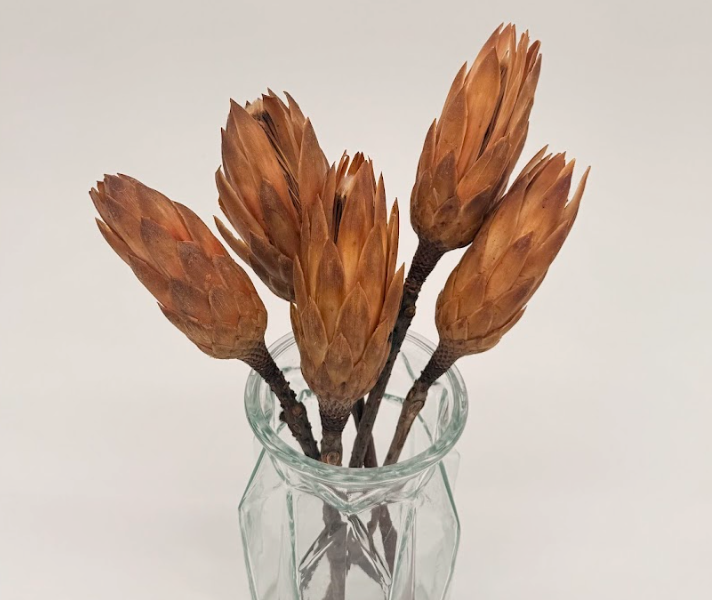
Dried protea is one of the most striking statement flowers in any arrangement — bold sculptural form, leathery petals that hold their structure for years, and earthy tones that anchor a bouquet around them. They suit modern, bohemian, and African-inspired interiors equally well, and need almost no care once placed.
If dried flowers had a showstopper — the stem that makes people stop scrolling and ask ‘what is that?’ — it would be the protea. These sculptural, architectural blooms look like they belong in a botanical illustration or a museum display case. They’re dramatic without being fussy, bold without being brash, and they dry into some of the most striking specimens in the entire dried flower world.
Here’s your guide to dried proteas — what they are, which varieties to look for, and how to style them at home.
What Are Proteas?
Proteas are a family of flowering plants native to South Africa and Australia. They’re named after Proteus, the Greek god who could change shape — fitting, because the protea family includes an extraordinary range of forms, from the giant king protea to the delicate pincushion varieties.
What makes proteas special for drying is their natural structure. The thick, waxy petals and dense flower heads hold their shape remarkably well during the drying process. Unlike more delicate flowers that shrink and curl, proteas retain their dramatic, sculptural form almost perfectly. The colour shifts from vibrant pinks and reds to deeper, moodier tones — burgundy, dusty rose, and warm brown — which many people find even more beautiful than the fresh version.
Popular Dried Protea Varieties
King protea (Protea cynaroides). The largest and most iconic variety. The flower head can reach 25cm across — a single stem in a vase is a complete arrangement in itself. Kings dry into magnificent, artichoke-like forms in deep burgundy and brown tones.
Banksia. Technically a separate genus but closely related and often grouped with proteas. Banksia flowers have a distinctive cylindrical shape with hundreds of tiny flowers arranged in rows. They dry into striking, textural specimens that look extraordinary in arrangements.
Pincushion protea (Leucospermum). Rounded flower heads with long, pin-like styles radiating outward. The shape is completely unique — nothing else in the dried flower world looks like this. They add a playful, structural element to any arrangement.
Compacta (Protea compacta). Smaller, more elongated heads than the king protea. These are easier to incorporate into mixed arrangements because their more modest size doesn’t overwhelm neighbouring stems.
Repens (Protea repens). Elegant, pointed flower heads with a sculptural quality. They dry into beautiful, papery forms that look like they’ve been carved from natural materials.
How to Style Dried Proteas
As a solo statement. A single king protea in a simple ceramic vase is one of the most striking things you can put on a shelf or table. The flower head is dramatic enough to stand completely alone — no other stems needed. This is minimalist styling at its most impactful.
As the focal point of an arrangement. In a mixed dried flower bouquet, a protea or banksia serves as the centrepiece — the eye goes there first. Surround it with softer, wispier stems like dried grasses, bunny tails, and eucalyptus to create contrast between the bold protea and the delicate textures around it.
In modern and sculptural interiors. Proteas suit architectural, design-led spaces particularly well. Their structured forms complement concrete, clean lines, and minimalist furniture in a way that softer dried flowers sometimes don’t. If your interior style leans modern rather than rustic, proteas are your best friend.
Care
Dried proteas are among the sturdiest dried botanicals. They shed very little, handle gentle movement well, and retain their shape for two to four years with basic care. The main thing to watch is dust accumulation in the dense flower head — a gentle brush with a soft paintbrush every few months keeps them looking clean.
Worth the Drama
Proteas aren’t subtle — and that’s exactly the point. If you want a dried flower that commands attention, starts conversations, and makes a space feel curated rather than just decorated, a dried protea does all of that with a single stem.
Our Helena Bouquet is one of our most popular arrangements featuring protea, making it a striking statement piece for any room.
Browse our dried protea collection and add some architectural drama to your space.
What Are Protea and Where Do They Come From?
Protea are an ancient plant family native to South Africa and parts of Australia. Some species — including the king protea, South Africa’s national flower — have been around for over 300 million years, making them one of the oldest flowering plant lineages on Earth. The family includes more than 1,400 species, but only a handful are commonly available in the dried flower trade.
The varieties most often used in dried arrangements are king protea (huge sculptural heads, often 10-15cm across), pincushion protea (the spiky, almost otherworldly leucospermum), silver-tree protea (smaller, with a soft silvery sheen on the petals), and blushing bride protea (a paler, more delicate variety with white-and-pink petals). Each gives a different effect — and many bouquets pair two or three together.
How Are Dried Protea Different from Other Dried Flowers?
Most dried flowers are delicate after preservation — papery petals, fragile stems, easily knocked askew. Protea are the opposite. The petals are naturally leathery and waxy in their fresh form, which means the drying process barely changes their structure. A dried protea looks essentially identical to a fresh one, with the same firmness and the same colour-richness for years.
This makes them the most damage-resistant dried flower you can buy. They survive rough handling, casual moves, and the occasional knock without losing petals or going limp. If you live with cats, small children, or just have a busy household, a protea-led arrangement will outlast any other dried bouquet in the home.
How Do You Style Dried Protea?
Protea are scale-stealing flowers. A single king protea in a vase is itself a whole arrangement — you do not need supporting stems, and adding more flowers can actually weaken the impact. The styling rule of thumb: let the protea breathe.
The Solo Statement
One king protea in a tall, simple ceramic or stoneware vase. That is it. This is one of the most photographed dried-flower arrangements on Pinterest and Instagram for a reason — the visual weight of a single protea against a quiet vase makes any room feel curated.
The Layered Bouquet
If you want a fuller bouquet, build around 2-3 protea heads as the visual anchors, then layer in supporting stems with much softer shapes — pampas grass plumes, dried eucalyptus, dried bunny tails, or wheat. The contrast between the bold protea and the airy supporting stems is what makes this composition work.
The Boho Wreath
Pincushion protea are often the focal flowers in boho-style dried wreaths — their spiky form gives a wreath energy and direction. Pair with dried palm spears, ruscus, and pampas for a fully boho aesthetic.
How Do You Care for Dried Protea?
Protea are the lowest-maintenance dried flower in the whole catalogue. Three rules cover everything:
- Keep them dry. The leathery petals can absorb humidity in muggy rooms. Avoid bathrooms and conservatories.
- Dust occasionally with a soft brush. A makeup brush works perfectly. The waxy petals do not hold dust the way papery flowers do, so a quarterly clean is fine.
- Indirect light only. Direct UV will eventually fade the deeper pinks and burgundies after a year or two — keep them in a north-facing or shaded position to hold colour for 3+ years.
For full care advice across all dried flower types, see our complete care guide.
Frequently Asked Questions About Dried Protea
How long do dried protea last?
Three to five years with proper care — significantly longer than the typical dried flower. The waxy, leathery petal structure makes them naturally resistant to the gradual fading and brittleness that affects other dried stems. Protea are widely cited as one of the most durable dried flowers — the leathery, almost waxy petal structure means they keep their form and colour far longer than papery dried alternatives.
Can dried protea fade?
Yes, but very slowly. Direct UV is the only meaningful threat. In indirect light, deep burgundy and pink protea hold their colour for 3+ years before any noticeable fade. In direct sunlight, expect noticeable fading within 12 months.
Are dried protea suitable for wedding bouquets?
Yes, increasingly so. King protea are particularly popular in modern bohemian and African-influenced wedding styling. They photograph beautifully, do not wilt, and survive outdoor summer ceremonies without trouble. See our wedding bouquets guide.
Why are dried protea more expensive than other dried flowers?
Protea are slow-growing, mostly imported from South Africa or Australia, and have a much lower yield per plant than common dried flowers like pampas or wheat. The shipping, careful handling, and lower production volume all push the price up. The trade-off is significantly longer lifespan in the home.
Can you mix dried protea with fresh flowers?
Technically yes, but it is not recommended. Fresh flowers need water, which over time will damage the leathery protea base if it sits in a wet vase. If you want both, use separate vases positioned together rather than mixing in one container.
Shop Our Wedding Flowers Collection
Explore our complete range of dried wedding bouquets, buttonholes, and ceremony arrangements.
Shop NowWhat rooms do dried protea suit best?
Living rooms, dining rooms, hallways, bedrooms, and home offices — anywhere with indirect light and stable temperature. Avoid bathrooms (humidity), kitchens directly above hobs (heat + grease vapour), and sun-flooded conservatories.